Notes after losing two boxes to grey squirrels.
Squirrels and owls want exactly the same thing: an enclosed wooden cavity, twelve feet up, with one small entrance hole. If you put up a nest box without thinking about squirrels, the squirrels will move in within a week. The five things that actually keep them out - in order of importance - are baffle type, mounting (pole, not tree), height, entrance hole size, and timing the install for owl breeding season. Get those right and the owls win.
Why this matters more than people think
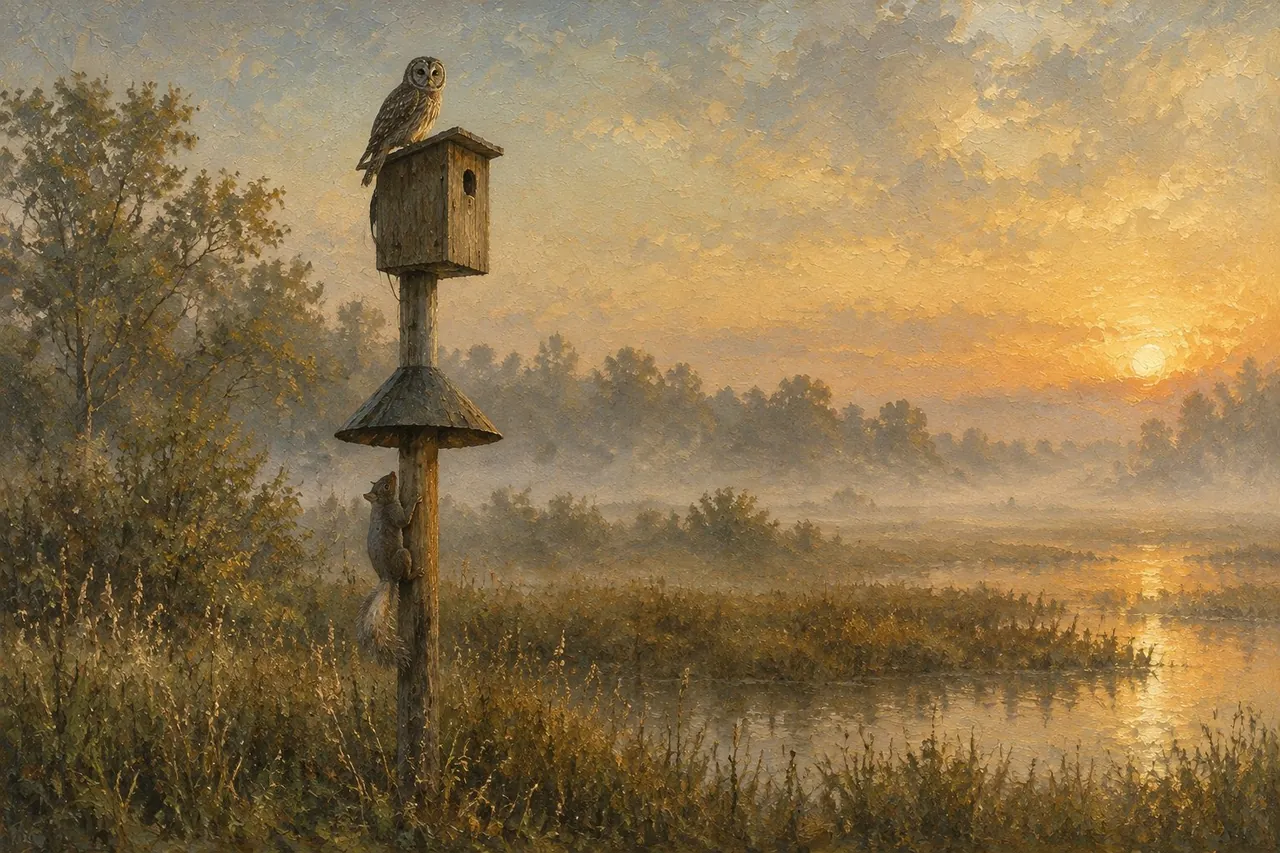
A nest box that gets occupied by a grey squirrel in autumn is gone for the season. Squirrels chew the entrance hole wider, line the box with leaves, and defend it from the inside. By the time a barred owl or screech owl scouts the box in late winter, it’s already a squirrel’s apartment - and the owl moves on.
The mistake is treating squirrel-proofing as something you do later, if there’s a problem. Squirrels arrive first. The defences have to be there before the box goes up.
The five things that actually work
In rough order of how much each one helps:
- A proper baffle on a smooth metal pole.
- Mount on a pole, not a tree.
- At least 12 feet up.
- Entrance hole sized exactly for your owl species.
- Install in late autumn, before squirrels select winter dens.
The first two do 80% of the work. The rest are refinements.
1. The baffle is the whole game
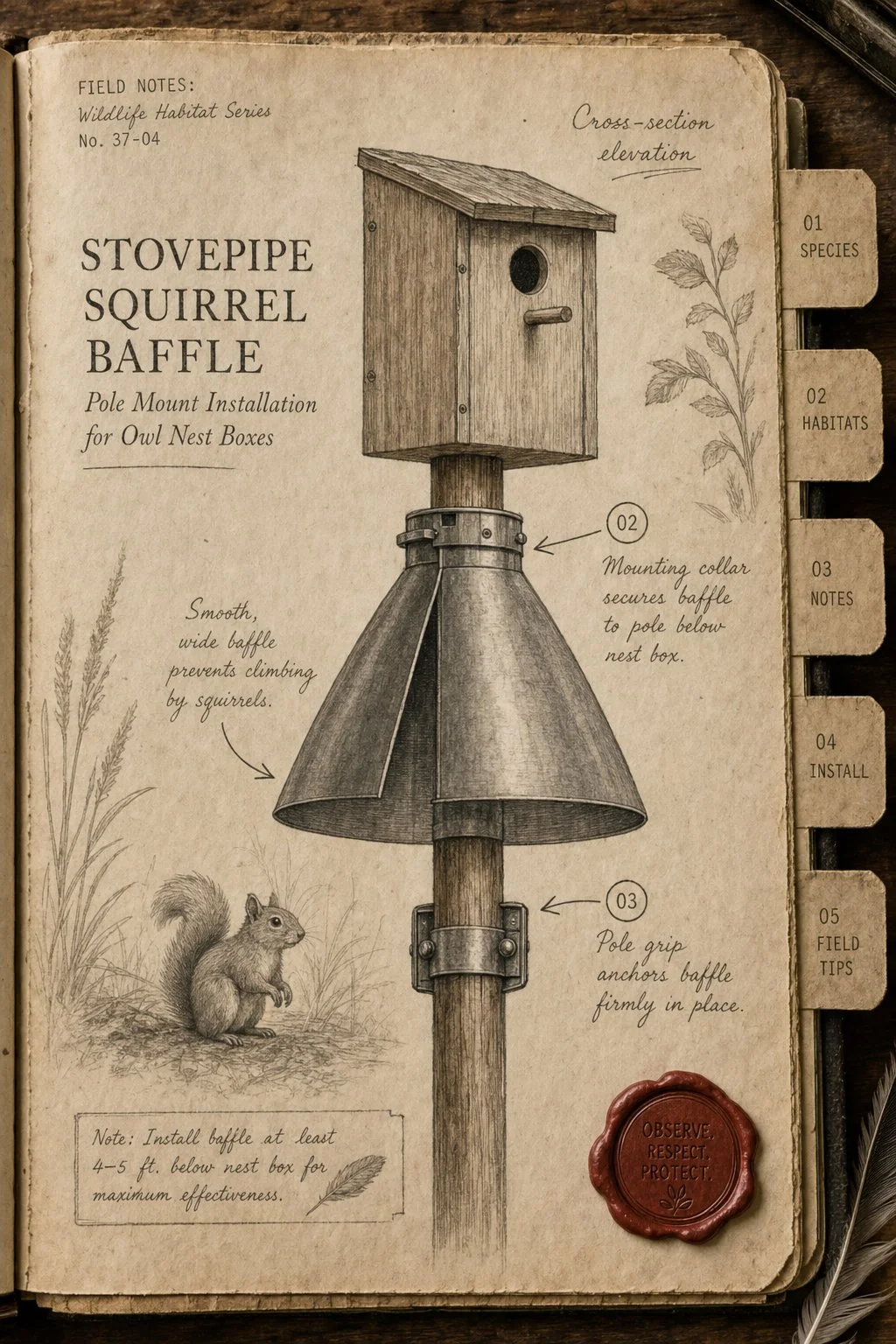
A baffle is a metal sleeve or cone mounted on the pole below the nest box. The squirrel runs up the pole, hits the baffle, and can’t get past it. Squirrels can’t climb over a properly-sized stovepipe baffle - it’s just too wide for them to grip around.
The two kinds that work:
- Stovepipe (torpedo) baffle - a cylindrical metal tube, 6+ inches in diameter, 16+ inches tall. The classic. Slips onto a 1-inch pole and clamps in place.
- Cone baffle - a wide inverted cone, harder to mount but works the same way.
The two kinds that do NOT work, despite being sold for the purpose:
- Slinky-style spring baffles - squirrels figure them out within a week.
- Greased poles - they wear off in rain and the grease isn’t good for owl feathers anyway.
Audubon Torpedo Squirrel Baffle
The baffle that actually works.
A steel torpedo-style baffle, 6.125 inches in diameter, designed to slip onto a standard pole below a nest box or feeder. Black powder-coated finish, weather-rated. Mounts in five minutes; squirrels stop in five seconds.
- Fits poles from 1/2 inch to 1 3/8 inch diameter
- 6.125-inch diameter steel - too wide for a squirrel to grip
- Powder-coated steel, holds up through wet winters
 Audubon · NATORPEDO

As an Amazon Associate we earn from qualifying purchases. Linked products are ones we actually use.

2. Pole-mount, not tree-mount
This is non-negotiable. If you nail your owl box to a tree trunk, a grey squirrel will be inside within ten days. The trunk is a perfect highway. No baffle made will help, because the squirrel doesn’t need to climb the pole - it just walks horizontally across a branch.
Use a free-standing pole, ideally at least three metres away from any tree the squirrel could leap from. Squirrels can jump roughly two metres horizontally and four metres downward. Plan accordingly.
Good pole materials:
- Galvanised steel pole (1 to 1.25 inch diameter) - the standard, paired with the baffle above
- PVC over rebar - cheaper, works if anchored properly
Bad pole materials:
- Wooden 4x4s - squirrels can climb wooden posts
- Tree trunks - see above
Before changing the box
Select what you know. The safest next step changes if occupancy is uncertain.
If you cannot confirm the box is empty, do not alter or block it. Seek local wildlife advice before any work.
Read the source: Barn Owl Trust: clearing out nest spaces.
3. Height: at least 12 feet
Squirrels can jump roughly two metres (six feet) straight up from ground or from a wall. The baffle’s lower edge should be at least eight feet off the ground; the nest box itself should be at least twelve feet up.
Twelve feet also matches the height range owls actually look for. Barred owls and screech owls both prefer cavity entrances 10-30 feet up. A box at six feet is the wrong height for everyone except squirrels.

4. Entrance hole sized for your owl
Squirrels will chew an entrance hole wider to suit them. A wooden box with a generously cut hole becomes a squirrel box within a season.
Two defences:
- Cut the hole to the exact diameter the target owl needs, no oversize. Eastern screech owl: 3 inches. Barred owl: 4 inches. Northern saw-whet: 3 inches.
- Reinforce the rim with a metal hole-guard. A 1/16-inch steel plate around the entrance stops squirrels chewing it wider. Cheap to add at install.
A 3-inch hole admits screech owls and small woodpeckers and excludes grey squirrels (which need ~4 inches to enter comfortably). Sizing matters.
5. Timing: install in late autumn
Squirrels select winter dens in late autumn, often by mid-November. Owls scout for spring nest sites between January and March. If you install a fresh box in October:
- Squirrels move in for the winter.
- Owls find a squirrel-occupied box in February and leave.
Better timing: install in late October or early November with all squirrel defences already in place. By the time squirrels arrive, the box is uninhabitable to them. By the time owls scout in January, it’s empty and ready.
If you missed autumn, install in summer for the following spring - any time the box can sit empty for a few months before owl scouting begins.
What to do if a squirrel has already moved in
If you’ve found one occupying the box mid-winter, removing it humanely is the job:
- Wait until the box is empty (squirrels leave to forage at first light).
- Plug the entrance hole loosely - rolled newspaper, removed easily.
- Install the baffle and any reinforcements.
- Remove the plug.
The squirrel will return, find the box defended, and select a different den within a few days. Don’t trap; it’s both illegal in some regions and unnecessary - good defences move squirrels along on their own.
The bottom line
The bird that ends up nesting in your box is decided more by your hardware than by luck. A torpedo baffle on a smooth steel pole, twelve feet up, three metres from the nearest tree, with a 3-inch metal-rimmed entrance hole, installed in October: that’s an owl box. Everything less than that is a squirrel apartment.
For more on attracting raptors to a garden generally, see our notes on the owls that take to nest boxes and our piece on when owl breeding season actually starts.